If you've searched "what is MTD ITSA" because the phrase keeps turning up in emails from HMRC, your accountant, or your bank, you're not alone — it's one of the most Googled tax acronyms in the UK right now, and most explanations assume you already know half the jargon. This post breaks it down properly: what the letters stand for, who it actually applies to, when it starts, and what you need to do about it, with no assumed knowledge.
What Does MTD ITSA Stand For?
MTD ITSA stands for Making Tax Digital for Income Tax Self Assessment. It's the government's programme to move Income Tax reporting for sole traders and landlords away from a single annual Self Assessment return and onto a system of digital record-keeping with quarterly updates submitted through compatible software.
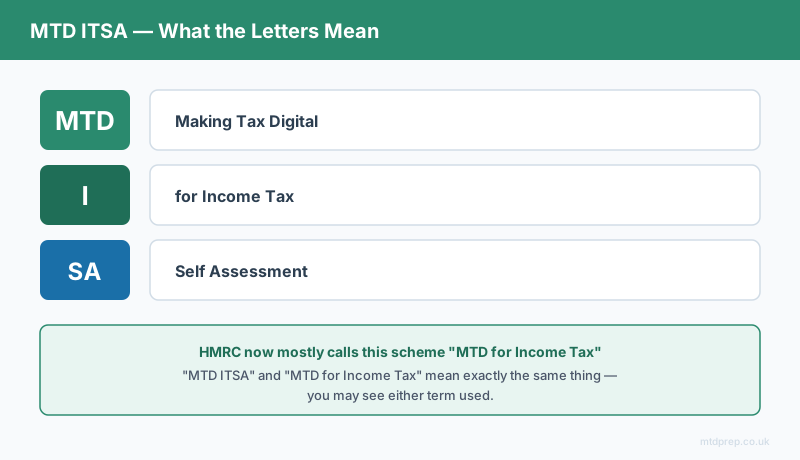
Worth knowing: HMRC itself has largely dropped the "ITSA" part in its own communications and now refers to it simply as "Making Tax Digital for Income Tax" or "MTD for Income Tax." You'll see both terms used interchangeably online — they mean exactly the same thing. If a page, letter, or advisor says "MTD for Income Tax" and another says "MTD ITSA," there's no difference between them.
Is MTD ITSA the Same as Making Tax Digital?
Not quite — "Making Tax Digital" is the umbrella name for HMRC's wider digitisation programme, which already includes MTD for VAT (live since 2019). MTD ITSA is the Income Tax branch of that same programme, specifically for sole traders and landlords. If you're VAT-registered, you may already be familiar with the general shape of MTD — quarterly digital updates instead of one big annual return — because MTD ITSA works on very similar principles, just for Income Tax rather than VAT.
Who Does MTD ITSA Apply To?
MTD ITSA applies to sole traders and landlords whose gross income — turnover, not profit — is above set thresholds. It's being introduced in phases rather than all at once.
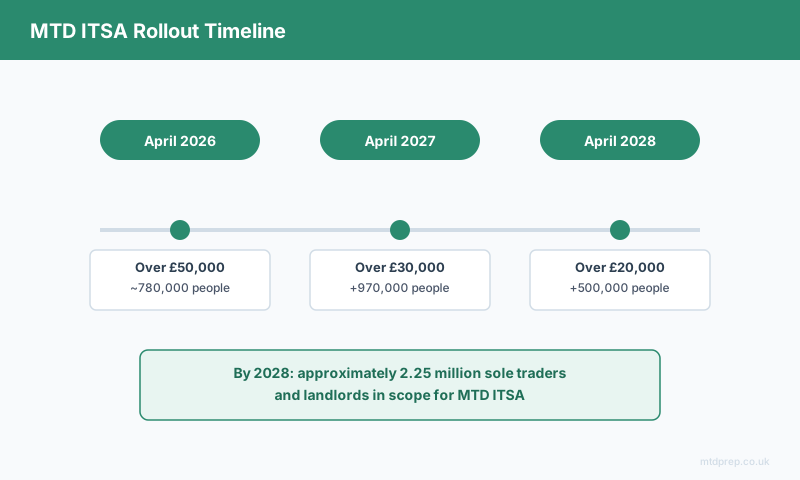
| From | Qualifying income threshold | Based on tax year | Estimated people affected |
|---|---|---|---|
| 6 April 2026 | Over £50,000 | 2024–25 | ~780,000 |
| 6 April 2027 | Over £30,000 | 2025–26 | +970,000 |
| 6 April 2028 | Over £20,000 | 2026–27 | +500,000 |
By 2028, HMRC expects around 2.25 million sole traders and landlords to be in scope. Qualifying income is your combined gross self-employment and property income before expenses are deducted, so someone with high turnover but modest profit can still be caught by the threshold. MTD ITSA does not apply to limited companies, and it does not apply to income that's only ever taxed through PAYE.
Following the November 2025 Budget, HMRC also confirmed an expanded set of permanent exemptions — including for people acting under a Power of Attorney or a Court of Protection deputyship — for cases where digital reporting genuinely isn't practical. If you think you might qualify for an exemption, that's worth checking directly with HMRC or an accountant rather than assuming either way.
What Do You Actually Have to Do Under MTD ITSA?
Once mandated, there are three ongoing obligations, replacing the old once-a-year Self Assessment habit:
Keep digital records. Every business transaction needs to be recorded digitally, close to when it happens, rather than reconstructed at year-end from paper receipts or bank statements. A structured spreadsheet is fine, provided it can connect to HMRC through MTD-compatible software.
Submit four quarterly updates. Due by 7 August, 7 November, 7 February and 7 May, each covering a rolling three-month period. These are summary totals of income and expenses, not full tax calculations — and if you run more than one business (a trade plus a rental property, for example), each needs its own set of quarterly updates.
Submit a year-end final declaration. Due by 31 January following the end of the tax year, replacing the old Self Assessment return and finalising your total tax position with any reliefs or allowances applied.
Do I Need to Buy Accounting Software for MTD ITSA?
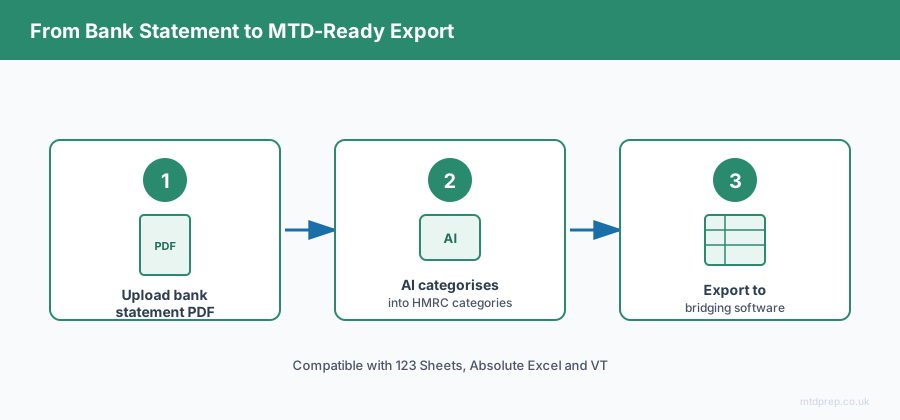
No. MTD ITSA requires MTD-compatible software, which is a broader category than full accounting platforms. Bridging software such as 123 Sheets, Absolute Excel, or VT lets you carry on managing your books in a spreadsheet while still submitting compliant, digitally-linked updates to HMRC — no need to move your entire financial life into a subscription platform you don't otherwise want.
The part that trips most people up is the "digitally linked" requirement: once your figures are digital, they need to flow through to your submission without manual retyping. Getting from a PDF bank statement to a clean, correctly categorised spreadsheet a bridging tool can pick up is exactly the gap MTDPrep is built to close.
Frequently Asked Questions
What does MTD ITSA stand for?
Making Tax Digital for Income Tax Self Assessment. HMRC now mostly calls it "MTD for Income Tax" in its own materials, but the two names refer to the same scheme.
Is MTD ITSA the same thing as MTD for Income Tax?
Yes. "MTD ITSA" was the original working name; HMRC has shifted to calling it "MTD for Income Tax" in newer guidance, but there is no difference in what the scheme requires.
Who has to comply with MTD ITSA?
Sole traders and landlords with combined gross income (before expenses) above £50,000 from April 2026, above £30,000 from April 2027, and above £20,000 from April 2028. It does not apply to limited companies or PAYE-only income.
Does MTD ITSA replace Self Assessment completely?
It replaces the annual Self Assessment return with four quarterly updates plus a year-end final declaration, so the reporting rhythm changes even though it's still fundamentally an Income Tax process.
Do I need new accounting software to comply with MTD ITSA?
No. You need software that's MTD-compatible, which includes bridging software like 123 Sheets, Absolute Excel, or VT — these work with spreadsheets you may already use, rather than requiring a full accounting subscription.
When exactly do the MTD ITSA quarterly deadlines fall?
7 August, 7 November, 7 February and 7 May each year, covering the preceding three-month period, followed by a final declaration due by 31 January.
Are there any exemptions from MTD ITSA?
Yes. HMRC has confirmed permanent exemptions for certain circumstances, including where someone is acting under a Power of Attorney or Court of Protection deputyship, alongside existing digital exclusion exemptions. Check your specific position with HMRC or an accountant.
Once you strip away the acronym, MTD ITSA is a change in reporting rhythm and record format, not a demand to overhaul how you run your business. Knowing what the letters mean, whether the thresholds apply to you, and that a spreadsheet-plus-bridging-software route is still valid is most of what you need to stop feeling behind on this.
Related: Making Tax Digital for Sole Traders 2026 · Making Tax Digital for the Self-Employed · MTD Bridging Software Explained
Found this useful? Add MTDPrep as a Google Preferred Source and our MTD guides will show up whenever you search the topics we cover.
MTDPrep is an independent product and is not affiliated with or endorsed by HMRC.